When Your Production Layout Changes, Can Your Crane System Keep Up?
Few production layouts stay the same for long. New products, new workstations and changes in process flow all affect how material moves across the shop floor. The overhead handling system you install today has to cope with the layout you will have tomorrow.
The hidden cost of a fixed system
When a handling system is built for one arrangement only, every change to the layout becomes a project of its own. Either the process is bent around the equipment, or the equipment is modified, and both cost time.
What modularity changes
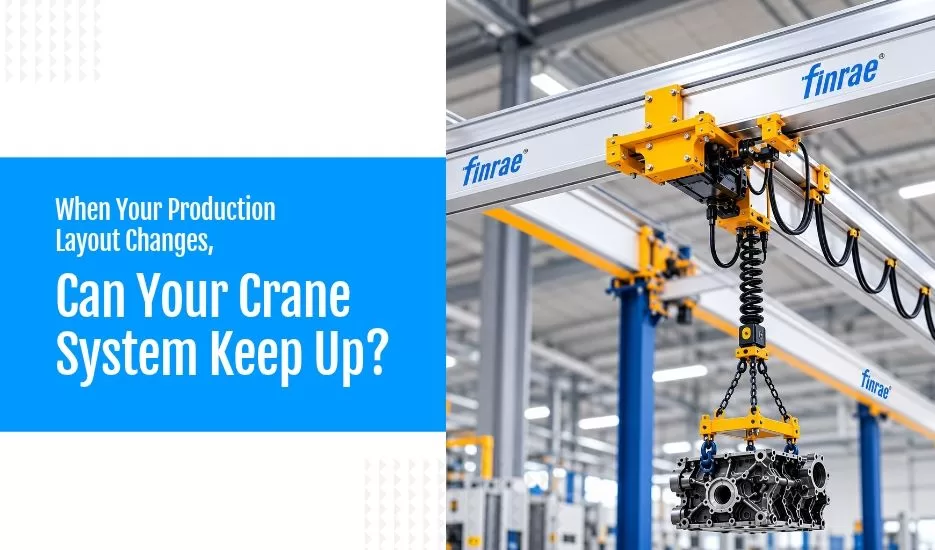
Finrae systems are built from standard aluminium crane profiles, joining sets, suspensions, trolleys and end caps. Because the system is modular and compact, configurations can be extended or reconfigured without welding or painting during assembly.
- Start simple: begin with a single rail system along a defined path.
- Grow with the process: move to a double rail or a cross-rail arrangement as the work area widens.
- Add reach or direction changes: use a telescopic system or curved rails where the route requires it.
Lightweight profiles help too
Lightweight aluminium profiles reduce the load on the overhead supporting structure, which gives more freedom when a layout is planned or modified.
Questions to ask before you choose
- Will workstations be added, moved or removed in the next few years?
- Can the rail be extended along the same structure?
- Can other equipment, such as hoists, balancers or grippers, be added later?
Next step
Tell us how your layout is likely to evolve and our engineers will suggest a configuration that can adapt. Talk to our engineers or explore the Finrae product range.