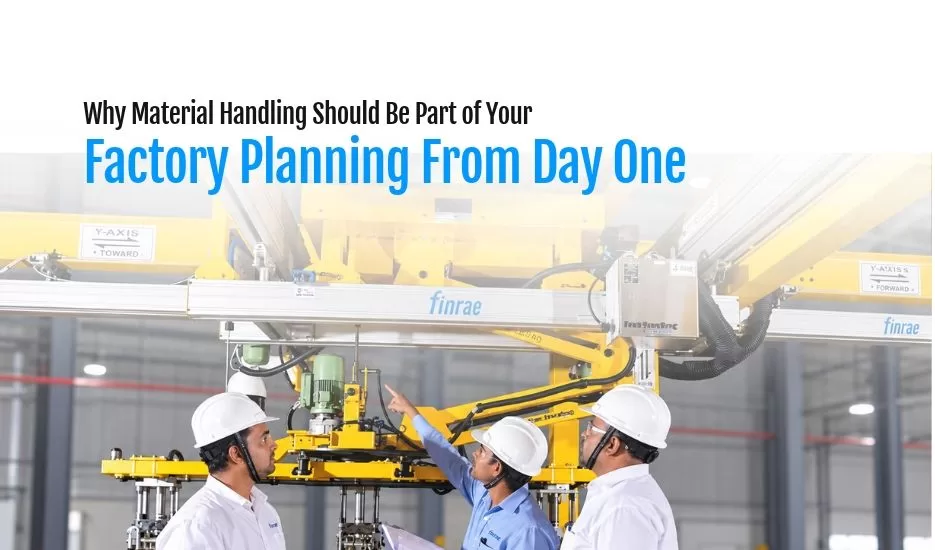
Why Material Handling Should Be Part of Your Factory Planning From Day One
When a new factory is being planned, attention naturally goes towards production capacity, machinery, utilities, floor space and process flow.
Manufacturers decide where machines will be installed, how workstations will be arranged and how materials will move through different stages of production.
Yet, the equipment required to physically handle those materials is sometimes considered only after the main layout has been finalised.
By then, several important decisions may already be difficult to change.
Including material handling in the early planning process can help manufacturers develop a more practical factory layout.
A Production Layout Is Also a Movement Plan
A factory layout defines more than the location of machines.
It determines how raw materials, components, tools and finished products move between operations.
Every transfer requires space, equipment and an appropriate handling method.
For example, a component may need to move from a fabrication station to an assembly fixture. A heavy tool may need to travel between several working positions.
If these movements are not considered during layout planning, the final arrangement may create unnecessary handling difficulties.
Studying movement requirements alongside production flow helps identify the handling systems needed at each stage.
Why Early Decisions Matter
Once machinery, utilities and supporting structures have been installed, introducing a new material handling arrangement may become more complicated.
Available overhead space may be restricted. Suitable mounting points may not be located where they are needed. Existing equipment may interfere with the proposed travel path.
These conditions can limit the options available to engineers.
Considering material handling during the initial design stage allows space, structural requirements and movement paths to be evaluated before the layout is finalised.
Making Better Use of the Available Workspace
Floor space is valuable in manufacturing facilities.
Depending on the application, overhead material handling systems can provide a way to move or support equipment without relying entirely on floor-based handling arrangements.
This may be useful where operators need access around workstations or where floor space is occupied by machinery and fixtures.
However, overhead systems also require suitable structural support, clearance and integration with the surrounding equipment.
The choice should be based on the specific handling requirement rather than floor-space considerations alone.
Planning for Different Types of Movement
Not every production operation involves the same kind of handling.
Some loads travel along a defined path. Others must reach several positions within a workstation or move between different process areas.
These differences influence the type of handling system required.
During factory planning, manufacturers should identify the loads, movement paths, operating frequency and equipment interfaces associated with each process.
This information provides a stronger basis for selecting rail systems, trolleys, suspensions and other handling components.
Preparing for Future Production Changes
Factories rarely remain unchanged throughout their operating life.
Production volumes increase, new products are introduced and workstations are modified to accommodate changing requirements.
Material handling systems should therefore be evaluated with possible future developments in mind.
Modular aluminium rail systems can provide options for extending or reconfiguring compatible components.
The feasibility of any modification depends on load capacity, supporting structures, system compatibility and engineering assessment.
Early consideration of these factors can help manufacturers make more informed decisions about future flexibility.
Bringing Material Handling Into Factory Design Discussions
Material handling should be part of the conversation between production planners, process engineers, equipment suppliers and facility designers.
Understanding how components and tools will move helps ensure that the required handling equipment can be integrated with the broader factory layout.
Finrae's modular aluminium rail systems, tool rails and associated components can be considered during the planning of industrial material handling applications.
The available profiles and configurations provide options for different load and movement requirements.
Planning a new factory or production line? Involve the Finrae team early to evaluate material handling requirements and explore suitable system configurations.